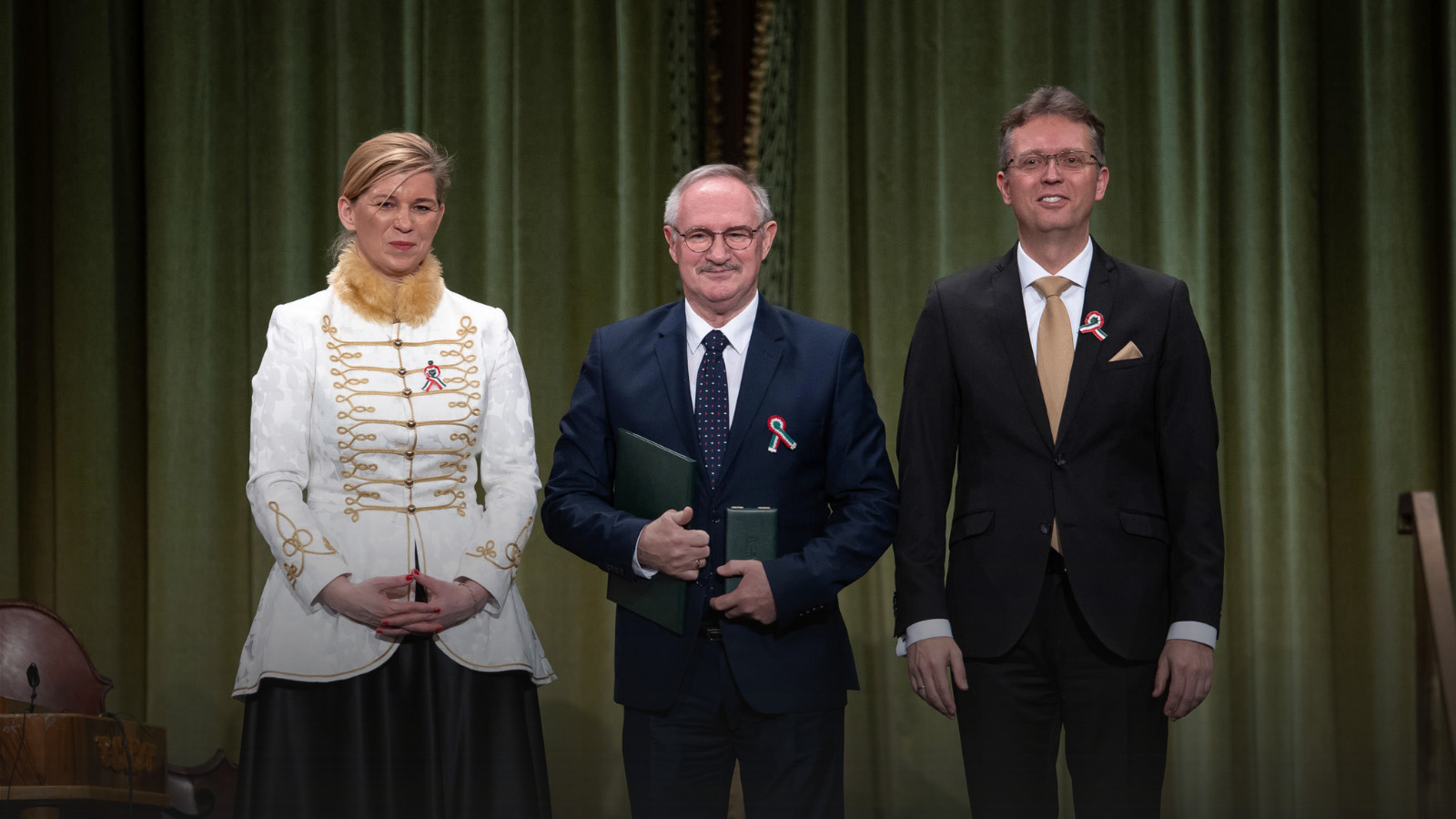
For his decades-long, dedicated work in Hungarian pharmacy and education, Dr. István Gábor Télessy, honorary associate professor at the Faculty of Pharmacy of the University of Pécs, has been awarded a prestigious state honor. The professional, who received the Knight’s Cross of the Order of Merit of Hungary, sets an example for younger generations not only through the diversity of his career but also through his values-driven approach.
The award, presented on March 13, 2026, at the Pesti Vigadó in connection with the March 15 national holiday, was granted in recognition of his work in “advancing the interests of the nation and enriching universal human values.”

According to Dr. Télessy, these principles were not consciously defined guiding rules, but rather naturally shaped his life path.
Throughout his career, he represented Hungarian science at numerous national and international professional events and worked actively to promote the values of Hungarian pharmaceutical education on a global level. His joint publications and collaborations with international colleagues also served this purpose.
He added that his actions have always been guided by what he considered right and fair. “I always tried to give meaning to each day, never avoided tasks, and completed everything I undertook with integrity,” he said, emphasizing that personal interests never came first for him.
Receiving the Knight’s Cross came as a surprise, but he regards it as important feedback. “You never know what kind of impact your work or thinking has on others. If you are honest, humane, and positive, that can only be a good thing,” he noted. The moment was made especially personal by receiving the award from a long-time professional acquaintance.
Dr. Télessy’s career is remarkably diverse, spanning nearly all areas of pharmacy. He has worked in community pharmacies, regulatory fields, pharmaceutical manufacturing both in Hungary and abroad, and in hospital settings. As he puts it, these experiences shaped his professional thinking not separately, but together. “The Creator always guided me to places where I could learn,” he recalled, highlighting the influence of his mentors during his university years, including Professors István Szórády, György Szemere, and Miklós Gábor. He also noted that earning additional degrees in economics and law alongside his work helped him better understand the perspectives of those “on the other side of the table.”
Regarding the present and future of the pharmacy profession, he is optimistic. He believes the profession is gaining renewed recognition. While it was once often viewed as a commercial activity, today its healthcare role is increasingly emphasized. The development of clinical pharmacy and the expansion of pharmacists’ competencies—such as prescription renewal and vaccination—indicate that pharmacists are becoming increasingly important partners within the healthcare system.
He offers a clear message to young people: this is a career worth choosing. The profession provides not only moral recognition but increasingly financial appreciation as well for those who work with up-to-date knowledge and dedication. At the same time, he stresses that solid, continuously updated knowledge is essential for long-term success and recognition—both among physicians and the wider public.
Looking ahead, his goal is not retirement but continued active engagement. He intends to carry on his teaching and professional work at the Faculty of Pharmacy of the University of Pécs, contributing to the education of future generations. “In teaching, I strive to present the beauty and diversity of our profession and to help guide students along this path. To achieve this, lifelong learning is also an essential responsibility for me—and one I gladly embrace,” he said.